Audi A/C Service in Riyadh
Full diagnosis and repair for Audi A/C: freon leaks, weak cooling, the compressor, and the condenser — pressure test and written report before any work, with a 12-month warranty.
Audi A/C service diagnoses and repairs the full cooling cycle: compressor, condenser, evaporator, and cabin filter, with the correct freon charge for each model.
Riyadh summers pass 45°C, and an Audi A/C runs at least 8 months a year — this constant load wears down the compressor and pushes circuit pressure above its normal limit.
Riyadh dust clogs the condenser and cabin filter 30% faster than in Europe, showing up gradually as weak cooling before the A/C stops working altogether.
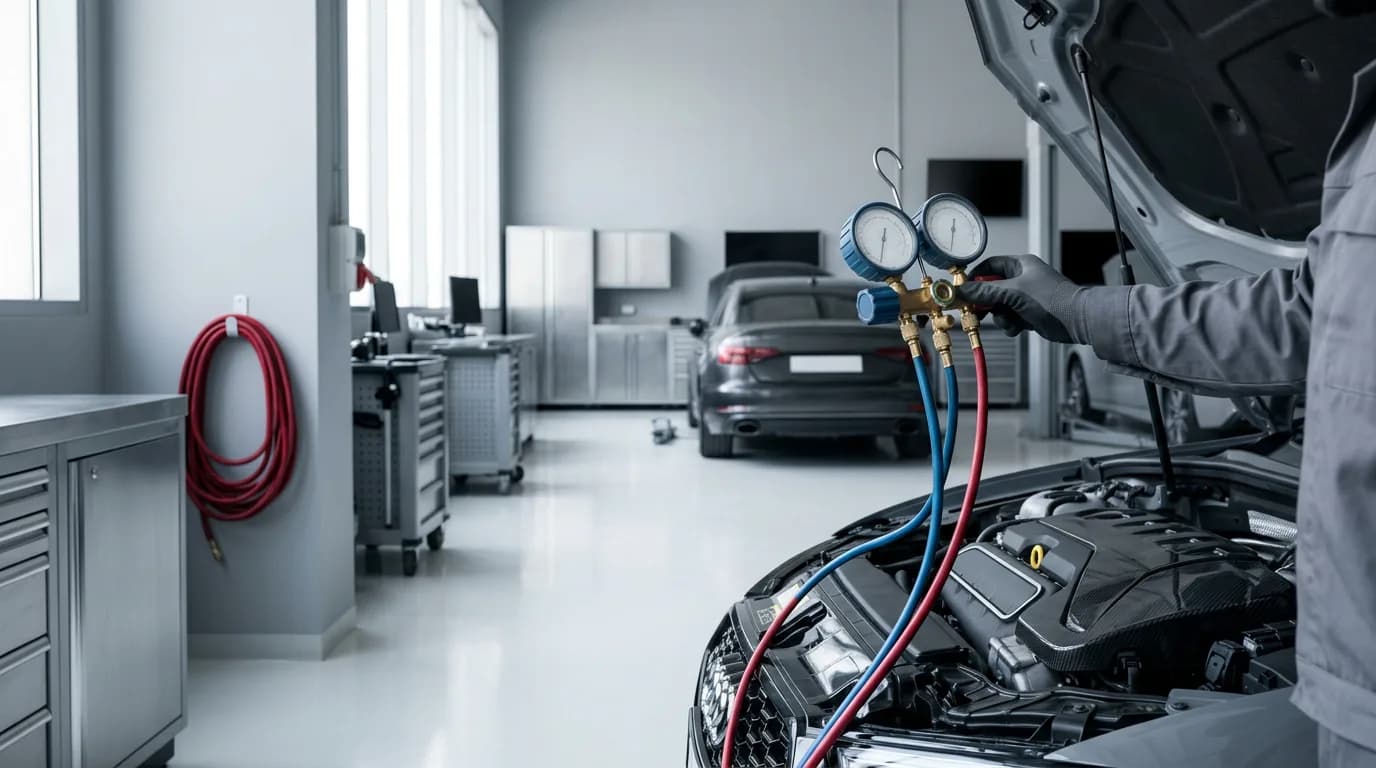
When does your Audi need A/C service?
Your Audi needs A/C service when cooling weakens even at the highest setting, a bad smell comes from the vents, a clicking sound occurs as the compressor engages, or cooling cuts out in traffic — each symptom is confirmed by a pressure test and pressure sensor reading.
- Weak cooling even at the highest setting
- Low freon, a leak in the circuit, or a condenser clogged with dust
- Bad smell from the A/C vents
- Bacteria and mold on the evaporator — needs cleaning and disinfecting
- Clicking sound as the compressor engages
- Worn compressor pulley or magnetic clutch — a warning before total failure
- Cooling cuts out in traffic
- The pressure sensor cuts the compressor as protection, or the condenser fan is weak
What does Audi A/C service include?
The service includes measuring freon pressure on both sides of the system, dye leak detection, condenser cleaning, compressor and pressure sensor inspection, evaporator disinfection, then charging freon with the type and quantity specified by the manufacturer.
- Freon pressure test (high and low side)
- Pressure measured with a charging station to determine the actual freon level
- Dye leak detection
- Fluorescent dye injected and the leak source traced with a UV lamp
- Condenser cleaning
- Removing dust buildup in front of the radiator to restore heat-exchange efficiency
- Compressor inspection
- Measuring current draw, noise, and magnetic clutch condition
- Evaporator disinfection
- Removing mold and the source of bad odor inside the A/C unit
- Pressure sensor
- Checking the reading and matching it against control unit data
- Freon charge
- R134a or R1234yf depending on model year, in the exact quantity specified by the manufacturer
What's the difference between R134a and R1234yf freon in Audi?
R134a supplies Audi models up to around 2017, while the more eco-friendly R1234yf replaces it in later models — the two refrigerants can't be mixed, and the chassis number determines the correct type before any charging.
The compressor pressurizes gaseous freon and pushes it to the condenser mounted directly in front of the radiator, where airflow from driving turns the freon from gas to liquid — this position makes the condenser the first part exposed to Riyadh dust.
The liquid freon then flows to the evaporator inside the dashboard, where it expands and cools the air entering the cabin while removing humidity, then returns as gas to the compressor to repeat the cycle.
The cabin filter cleans the air before it reaches the evaporator, and the pressure sensor continuously monitors both sides of the system, cutting the compressor as protection whenever pressure exceeds the safe limit.
- Compressor
- Pressurizes gaseous freon — the pressure sensor cuts it off at dangerous levels
- Condenser
- Directly in front of the radiator — most exposed to dust clogging
- Evaporator
- Inside the dashboard — cools the air and removes humidity
- Cabin filter
- Cleans air before the evaporator — replaced every 20,000 km
- Pressure sensor
- Monitors the high and low sides, protects the compressor from damage
- R134a freon
- Audi models up to roughly 2017
- R1234yf freon
- Audi models after roughly 2017 — lower environmental impact
How do we fix Audi A/C at our workshop?
We start by reading the pressure sensor and A/C control unit codes with a VCDS scanner, then measure freon pressure and detect leaks with dye, followed by a written cost report before any work opens the system — and after the repair we charge the exact freon quantity and test cooling on the road.
Reading the control unit
Scanning the Audi A/C unit with VCDS/ODIS and reading the pressure sensor and fault codes.
Pressure test and leak detection
Connecting a charging station to both sides of the system and injecting UV dye to pinpoint the leak source.
Written report and quote
Identifying the required work — charging, leak repair, or compressor replacement — with a clear price before opening anything.
Repair
Carrying out the work with genuine or OEM parts, cleaning the condenser and evaporator when needed.
Vacuum and freon charge
Evacuating air and moisture from the circuit (vacuum), then charging freon with the manufacturer's exact quantity.
Final test and handover
Measuring vent output temperature and a road test, then handover with a written 12-month warranty.
What parts are used to repair Audi A/C?
We use a genuine or OEM A/C compressor, a genuine cabin filter, and new O-rings with every circuit opening — plus freon to the exact factory spec, R134a or R1234yf depending on the chassis number.
- A/C compressor
- Genuine or approved OEM, with warranty
- Cabin filter
- Genuine — replaced with every full A/C service
- O-rings
- Mandatory replacement whenever any circuit connection is opened
- Freon
- R134a or R1234yf to original spec, depending on model year
Does Audi A/C differ by model?
Yes; larger family SUVs like the Q7 and Q5 carry a bigger cooling circuit and higher operating load due to their spacious cabins, while the A4 and A6 share closely related components — each model has its own full service page.
Ready to look at your car today
Initial computer diagnosis and a written report before any repair.
How much does Audi A/C service cost?
Freon charging with a leak check starts from SAR 250, a full A/C service from SAR 400, and compressor replacement from SAR 1,800 — the final figure is confirmed in a written report after inspection and before any work begins.
| Service | Indicative range (SAR) |
|---|---|
| Code reading + diagnostic road test | 150 – 250 |
| Cabin filter | 100 – 180 |
| Freon charge + leak check | 250 – 450 |
| Full A/C service | 400 – 1,200 |
| A/C compressor (replacement) | 1,800 – 3,500 |
Why fix your Audi A/C with us?
Because we measure pressure and identify the cause of weak cooling before charging any freon — we never charge over an unfixed leak, and we match the correct freon type to the chassis number, with a written 12-month warranty on parts and labor.
- Precise pressure testing
- We identify the cause of weak cooling before any freon charge
- The correct freon
- We match R134a or R1234yf to the chassis number before charging
- Warranty
- 12 months written on parts and labor
Where do we serve you in Riyadh?
Our workshop is on King Abdulaziz Road in Olaya, and we serve Audi owners across every district of Riyadh from Olaya to Khurais and southern Riyadh, with mobile service available for initial inspection when needed.
- Does charging the wrong freon damage Audi A/C?
- Yes; mixing R134a with R1234yf damages the rubber O-rings and ruins the compressor within a short time — that's why we match the freon type to the chassis number before any charging.
- How often does Audi A/C need service?
- The cabin filter is replaced every 20,000 km, and a full pressure and cooling check every 10,000 km as part of routine maintenance — Riyadh dust shortens filter life by 30% compared with the European average.
- Is a bad smell from Audi A/C dangerous?
- Not dangerous to the engine, but it signals bacterial contamination in the evaporator that affects cabin air quality, and it's treated by cleaning and disinfecting the unit directly.
- Why does Audi A/C cooling weaken specifically in traffic?
- Traffic reduces the airflow across the condenser, raising system temperature until the pressure sensor steps in to protect the compressor — a weak or dirty condenser fan makes it worse.
- Should I charge freon myself with a can from the market?
- Not recommended; off-the-shelf freon cans don't measure the exact quantity or check for leaks, and they introduce air and moisture that damage the compressor later — testing with specialized equipment identifies the real cause first.
- How long does an Audi A/C compressor repair take?
- One to two working days depending on genuine part availability, including evacuating and recharging the circuit plus a final road test before handover.
Related
- Audi Cooling & OverheatingThe general cooling system works alongside the A/C to protect the engine from Riyadh heat
- Audi Service PricesFull price list for every Audi service
- Audi Genuine PartsGenuine compressors and A/C filters for every model
- Caring for your Audi in Riyadh heatThe complete guide to protecting your Audi from Riyadh's extreme heat
Book Audi A/C Service in Riyadh now