Audi Air Suspension Repair
Inspection and repair of air suspension and conventional shock absorbers for every Audi model: membrane leaks, suspension compressor, height sensors, and the shock warning light — under a 12-month written warranty.
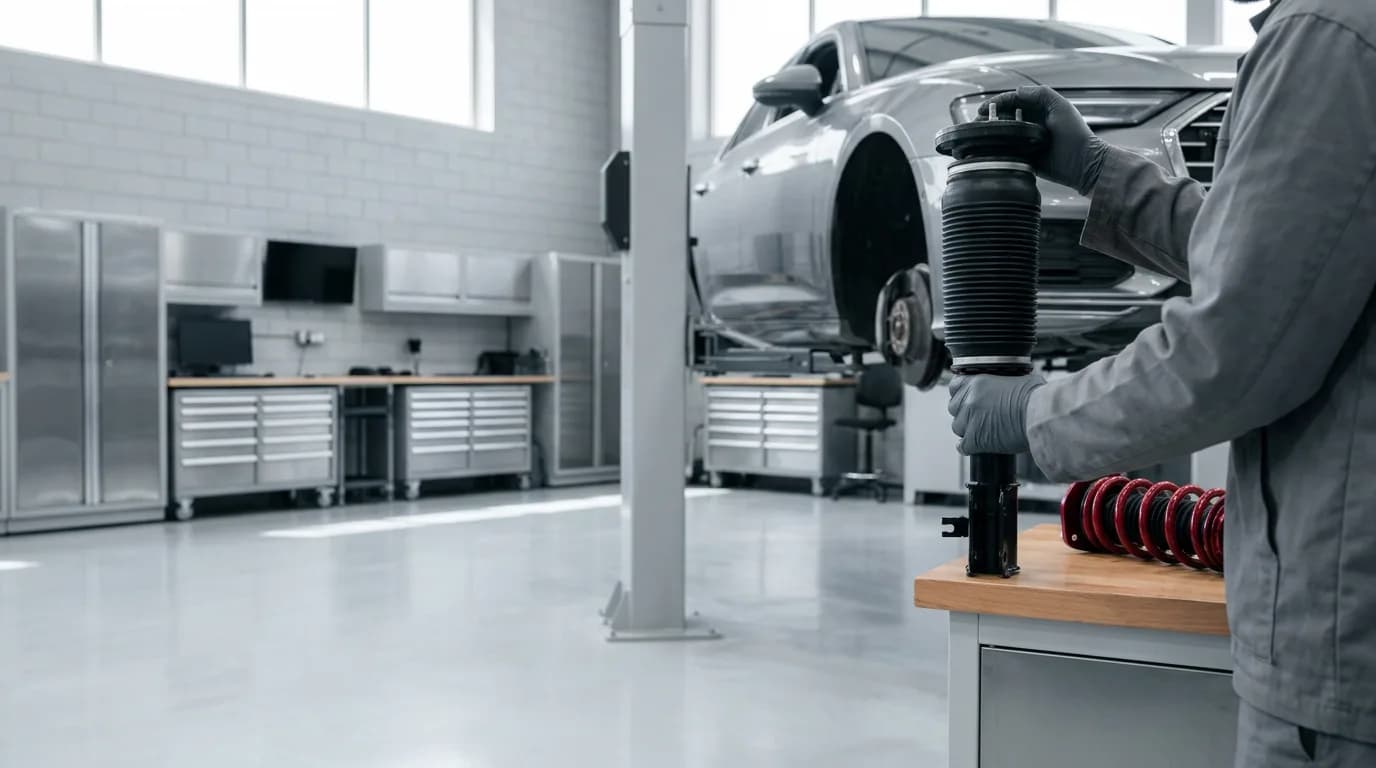
Audi shock absorbers are the suspension components that absorb road shocks and stabilize the body at each wheel.
The Q7 and A8 come with adaptive air suspension — four air springs in place of steel coil springs — while the A6 and A7 offer it as an option in certain generations, and smaller models rely on conventional hydraulic shocks.
The air suspension system pairs one air spring per wheel with a central compressor, a distribution valve block, and four height sensors — a fault in any one of these parts shows up as a sagging corner, a tilt, or a warning light on the dashboard.
Owners often call this system the Audi's 'air bags', and its most common Riyadh fault starts as a small leak in the rubber membrane before it worsens into a full collapse.
When do you need an Audi shock absorber inspection?
You need a shock inspection when one corner sags after a full night parked, when the compressor runs continuously for a long stretch, when the car leans to one side, or when a low-ride message and suspension warning light appear on the dashboard.
- One corner sags after a full night parked
- A leak in the rubber membrane of the air spring
- Compressor runs non-stop for several minutes
- It is compensating for a continuous leak and overheats to the point of burning out
- Noticeable lean to one side while driving
- A faulty height-sensor reading or a leak in one of the air springs
- "Vehicle too low" message on the dashboard
- A fault in the control unit or the distribution valve
- Yellow suspension warning light
- Degraded system performance — needs inspection soon
- Red suspension warning light
- Stop driving immediately — risk of the body contacting the ground
What does Audi shock absorber service include?
Shock absorber service includes a soap-solution leak test, replacing a damaged air spring, checking the compressor and distribution valve, calibrating the height sensors with a VCDS tool, and inspecting conventional shocks on models without an air system.
- Rubber membrane leak test
- Soap solution sprayed on every air spring after the car is lifted
- Air spring replacement
- Removing the damaged unit and fitting a genuine or approved Continental spring
- Compressor check
- Measuring charge time and current draw to detect heat stress
- Distribution valve block
- Checking for internal leaks between the four air lines
- Height sensor calibration
- Resetting the readings with VCDS after any mechanical work
- Conventional shock inspection
- Checking for hydraulic oil leaks and worn rubber around the shaft
How does Audi's air suspension system work?
Air suspension replaces the steel coil spring with a rubber air spring at each wheel, filled by a central compressor through a distribution valve, while four height sensors automatically adjust the body's ride height for load and speed.
The air spring is a folded rubber bellows that expands with compressed air instead of a steel spring, raising or lowering the body on command from the control unit.
The compressor pumps air to each spring through the distribution valve block, the valve that directs air to a single wheel or to all four together.
Riyadh's summer heat, above 45°C, dries out the membrane rubber faster than in a European climate, so the first leak cracks appear before the car's expected service life.
- Air spring
- A folded rubber bellows that fills with air instead of a steel coil spring
- Compressor
- Pumps compressed air to all four springs through the distribution valve
- Distribution valve block
- Directs air to each wheel individually on command from the control unit
- Height sensors
- Four sensors that read body height at each wheel and report it to the computer
- Yellow suspension light
- Degraded system performance — drive cautiously for a short distance
- Red suspension light
- Complete loss of ride-height control — stop driving immediately
How do we repair Audi shock absorbers?
We lift the car and leak-test every shock with soap solution, then read the suspension control unit's codes with VCDS, issue a written cost report before opening anything, and after replacement we calibrate the height sensors and road-test the car.
Visual check and lift
We lift the car, measure the ride height at each corner, and look for oil leaks or visible rubber cracks.
Soap-solution leak test
We spray soap solution on every air spring and watch for bubbles to pinpoint the exact leak.
Reading the suspension control unit
We scan the control unit with VCDS/ODIS and log the codes and height-sensor readings.
Written report and quote
We identify the responsible part — spring, compressor, or sensor — with a clear price before any disassembly.
Repair and replacement
We fit the damaged part with a genuine or approved Continental part matching your chassis number.
Calibration and road test
We calibrate the height sensors and road-test the car to confirm the body sits level.
Which parts do we use to repair Audi shock absorbers?
We use genuine air springs or parts from Continental, Audi's original supplier, an approved compressor, and height sensors matched to your chassis number — every part is covered under the 12-month written warranty.
- Air spring
- Genuine or Continental — the original supplier for the Q7, A8, A6 and A7
- Compressor
- Genuine or approved, with a new internal relief valve
- Height sensor
- Genuine, matched to the chassis number — four separate units
- Distribution valve
- Genuine, with new sealing rings at every disassembly
- Conventional shocks (smaller models)
- Sachs, the original supplier — always replaced as a pair
Does the suspension system differ by Audi model?
Yes; the Q7 and A8 come with adaptive air suspension and four air springs from the factory, the A6 and A7 offer it as an option in certain generations, while the A3, A4 and Q3 rely on conventional hydraulic shocks with no air system.
Ready to look at your car today
Initial computer diagnosis and a written report before any repair.
How much does Audi shock absorber repair cost?
Replacing one air spring on a Q7 or A8 starts from SAR 2,200, the compressor from SAR 1,800, and conventional shocks as a pair from SAR 1,200 — the final figure is confirmed in a written report after the leak test.
The model multiplies the base price: ×1.2 for the A6, A7 and Q7 for V6 parts and extra labor hours, and ×1.4 for the A8 for flagship-class parts.
| Service | Indicative range (SAR) |
|---|---|
| Code read + diagnostic road test | 150 – 250 |
| Air leak inspection and repair | 300 – 700 |
| Air suspension spring (each, Q7/A8) | 2,200 – 4,200 |
| Air suspension compressor | 1,800 – 3,200 |
| Conventional shocks (pair) | 1,200 – 2,600 |
Why repair your Audi shocks with us?
Eight VW Group-certified technicians run a soap-solution leak test before any replacement, we use genuine Continental parts, and every job carries a 12-month written warranty on parts and labor.
- Precise testing before replacement
- A soap leak test pinpoints the actual spring instead of guessing at all four
- Genuine parts
- Continental, the original supplier for Audi's air springs
- Programming and calibration
- VCDS and ODIS to set the height sensors to factory specification
- Warranty
- 12 months, written, on parts and labor
Where do you repair Audi shocks in Riyadh?
Our workshop is on King Abdulaziz Road in Al Olaya, and we receive cars by tow truck when the suspension system fails completely — we serve Khurais, north Riyadh and east Riyadh the same day.
- Can I drive with a red suspension warning light on?
- No, it isn't safe; the red light means the system has stopped raising the body, and driving lets the tire contact the bodywork, adding damage to the brakes and suspension. Call for a tow immediately.
- How long does an Audi air spring last?
- There is no fixed schedule; Riyadh's summer heat above 45°C dries out the membrane rubber faster than in Europe, so the first signs of a leak appear earlier than the car's expected life.
- Do all four air springs need replacing together?
- No; we replace only the leaking spring after the soap test, and add the other three only if the same test shows general wear in them.
- What's the difference between the yellow and red suspension lights?
- Yellow means degraded system performance with cautious short-distance driving still possible, while red means a complete stop that prevents the body from rising and calls for stopping immediately.
- Does the warranty cover air suspension parts?
- Yes; every spring and compressor we fit is covered under the 12-month written warranty on parts and labor.
- Do you repair air suspension on cars bought outside the dealership?
- We service every Audi regardless of where it was purchased, using genuine Continental parts and the same VCDS and ODIS tools approved by the dealership.
Book Audi Air Suspension Repair now