Audi Brake Service — Pads & Discs
Inspection and replacement of genuine Audi brake pads and ventilated discs for every model: diagnosing squealing and vibration, replacing worn pads and discs, and calibrating the electronic parking brake — backed by a written 12-month warranty.
Audi's brake system combines pads, ventilated discs, a wear sensor, and an electronic parking brake, and it directly determines the car's stopping distance.
Front pads wear faster than rear pads because braking shifts most of the car's weight onto the front axle, and models like the Q7 and A8 — over 2 tons — wear through pads faster than the A4 and A3.
We work with the electronic parking brake (EPB), which requires activating service mode with a VCDS tool before opening the rear pads, and we replace DOT4 brake fluid every 40,000 km as part of the scheduled maintenance.
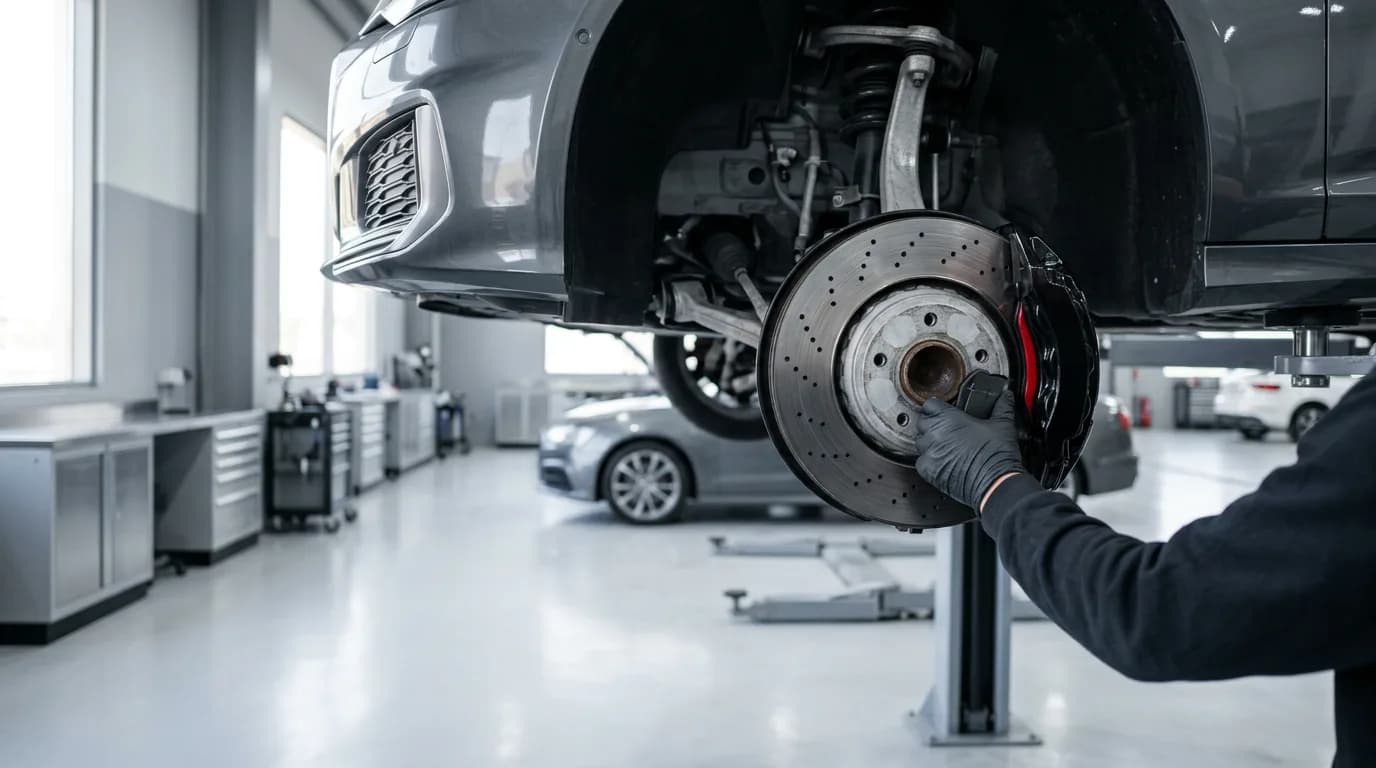
When does your Audi need new brakes?
You need an immediate inspection if you hear a metallic squeal from the wheel, feel the steering wheel shake under braking, see the brake pad warning light on the dashboard, or notice a longer stopping distance — each sign points to a specific cause.
- Metallic squeal when braking
- The metal wear indicator is touching the disc — the pads have reached their limit
- Steering wheel shakes when braking
- A disc warped by excess heat or uneven thickness
- Brake pad light on the dashboard
- A signal from the electrical wear sensor in the pad
- Longer stopping distance
- Hardened, glazed pads or a polished disc that's lost its grip
- Pedal vibration under pressure
- An uneven front disc that needs machining or replacement
What does Audi brake service include?
The service includes checking pad and disc thickness, replacing front or rear pads, machining or swapping ventilated discs, calibrating the electronic parking brake by computer, and changing DOT4 brake fluid when it's due.
- Front pads
- Thickness checked every service, replaced at the minimum limit
- Rear pads
- Replaced with mandatory EPB service mode before removal
- Front ventilated discs
- Thickness and runout measured, machined or replaced
- Wear sensor
- Replaced with the pad when the sensor is built into it
- DOT4 brake fluid
- Full change every 40,000 km — it absorbs moisture over time
How does the Audi brake system work?
Front discs are ventilated with internal channels that dissipate heat, while the rear discs are usually solid for a lighter load; the electronic parking brake (EPB) replaces the traditional hand lever with an electric motor inside each rear caliper.
The pad presses against the disc through a hydraulic piston, stopping the car by friction; the ventilated front disc cools faster because the front axle carries most of the braking force during a sudden stop.
Audi's electronic parking brake (EPB) drives a small motor that pushes the rear caliper piston; opening the rear pads without activating Service Mode with a VCDS or ODIS tool damages the motor because it stays engaged during removal.
DOT4 brake fluid is a hydraulic fluid that gradually absorbs moisture from the air; the moisture lowers the fluid's boiling point and weakens braking under repeated use — so it's fully replaced every 40,000 km regardless of how it looks.
- Front disc
- Ventilated with internal cooling channels — handles higher heat
- Rear disc
- Usually solid — lighter braking load
- Electronic parking brake (EPB)
- Electric motor in each rear caliper — needs service mode before removal
- DOT4 brake fluid
- Changed every 40,000 km — absorbs moisture and weakens braking if neglected
- Wear sensor
- A wire or metal contact that touches the disc once the pad runs out
How do we replace Audi brakes?
We measure pad and disc thickness with a caliper gauge, read the wear sensor with a VCDS tool, hand over a written report and quote, replace the pads or discs, activate service mode for the electronic parking brake when needed, then road-test the car.
Thickness inspection
Measuring pad and disc thickness with a caliper gauge on all four wheels.
Reading the wear sensor
Checking the brake control unit (Unit 03) with a VCDS/ODIS tool and logging the wear values.
Written report and quote
Identifying the required pads and discs with a clear price before any disassembly.
Replacing pads and discs
Removing the wheel, fitting genuine pads and discs, and cleaning the caliper.
Service mode for the electronic brake
Activating Service Mode with a VCDS tool before opening the rear pads and deactivating it after installation.
Final road test
A gradual braking test to bed in the new pads on the disc, then handing over a written 12-month warranty.
What parts go into Audi brakes?
We use genuine or OEM pads and discs from Continental (ATE) and Bosch, matched exactly to the chassis number and car model — and every part is covered by the written warranty.
- Pad set
- Genuine or OEM from Continental / Bosch
- Ventilated discs
- Genuine, matching the thickness and diameter spec for each model
- Wear sensor
- Genuine, matched to the caliper type
- Brake fluid
- DOT4 to factory spec
Do Audi brakes differ by model?
Yes; the Q7 and A8, at over 2 tons, wear through pads and discs faster than the A4 or Q5, and their parts are larger and cost more — Audi A8 pads are priced at a ×1.4 model multiplier over the base price.
Ready to look at your car today
Initial computer diagnosis and a written report before any repair.
How much does it cost to replace Audi brakes?
Genuine front pads start from SAR 450, a front pad-and-disc set from SAR 1,200, and rear pads with electronic parking brake calibration from SAR 500 — the final price is confirmed in a written report after inspection.
| Service | Indicative range (SAR) |
|---|---|
| Front pads (genuine) | 450 – 900 |
| Front pads + discs | 1,200 – 2,400 |
| Rear pads + electronic parking brake calibration | 500 – 950 |
| Pad sensor + warning light reset | 150 – 300 |
| Brake fluid (full change) | 250 – 400 |
Why service your Audi brakes with us?
Because we have a VCDS/ODIS tool to safely activate service mode for the electronic parking brake, and we fit genuine pads and discs matched to each model, with a written report before the work and a 12-month warranty after it.
- Genuine EPB calibration
- VCDS service mode protects the caliper motor from damage
- Model-matched parts
- Pads and discs in the correct size for every chassis
- Warranty
- 12 months written on parts and labor
Where do we serve you in Riyadh?
Our workshop is on King Abdulaziz Road in Al Olaya, and we handle urgent brake cases from every district of Riyadh with towing when needed — from Khurais in the east to North Riyadh.
- Is there a difference between brake pads and brake linings?
- None; pads and linings are two names for the same part that presses against the disc — linings is the everyday term many drivers in Riyadh use, while pads is the standard technical term for it.
- How long do Audi brake pads last?
- Front pads last 30,000–50,000 km under normal driving, less in the Q7 and A8 due to their extra weight; aggressive driving or constant traffic shortens the life to around 20,000 km.
- Does a squealing noise mean immediate replacement?
- Usually yes; a metallic squeal signals that the wear sensor has started touching the disc, and continuing to drive turns a cheap pad replacement into a costlier disc machining or replacement job.
- Why are Audi A8 pads more expensive than A4 pads?
- Because the A8 weighs hundreds of kilograms more than the A4, so its discs and pads are larger to handle higher braking heat, and its price is calculated with a ×1.4 model multiplier over the base price.
- Does the electronic parking brake need special maintenance?
- Yes; opening the rear pads without VCDS service mode damages the electric caliper motor, so the electronic parking brake needs computer calibration with every rear pad replacement.
- Does brake fluid need periodic replacement?
- Yes; DOT4 brake fluid absorbs moisture from the air and gradually weakens even when it still looks clear, so we replace it fully every 40,000 km as part of the scheduled maintenance.
Book Audi Brake Service — Pads & Discs now