Audi Overheating & Cooling Repair
Fast diagnosis and repair for Audi overheating: water pump, thermostat, flange, radiator, and fan — a coolant pressure test with every visit and a written 12-month warranty.
Audi cooling system service diagnoses and repairs the engine's cooling circuit — pump, thermostat, radiator, and fan — to stop Audi overheating before it starts.
Overheating is a symptom, not a cause; every Audi that runs hot has one specific part failing behind it — a cracked water pump, a stuck thermostat, or a radiator clogged with dust.
Riyadh summers above 45°C expose any weakness in the circuit within weeks, turning a minor leak into full overheating in long traffic on the ring road.
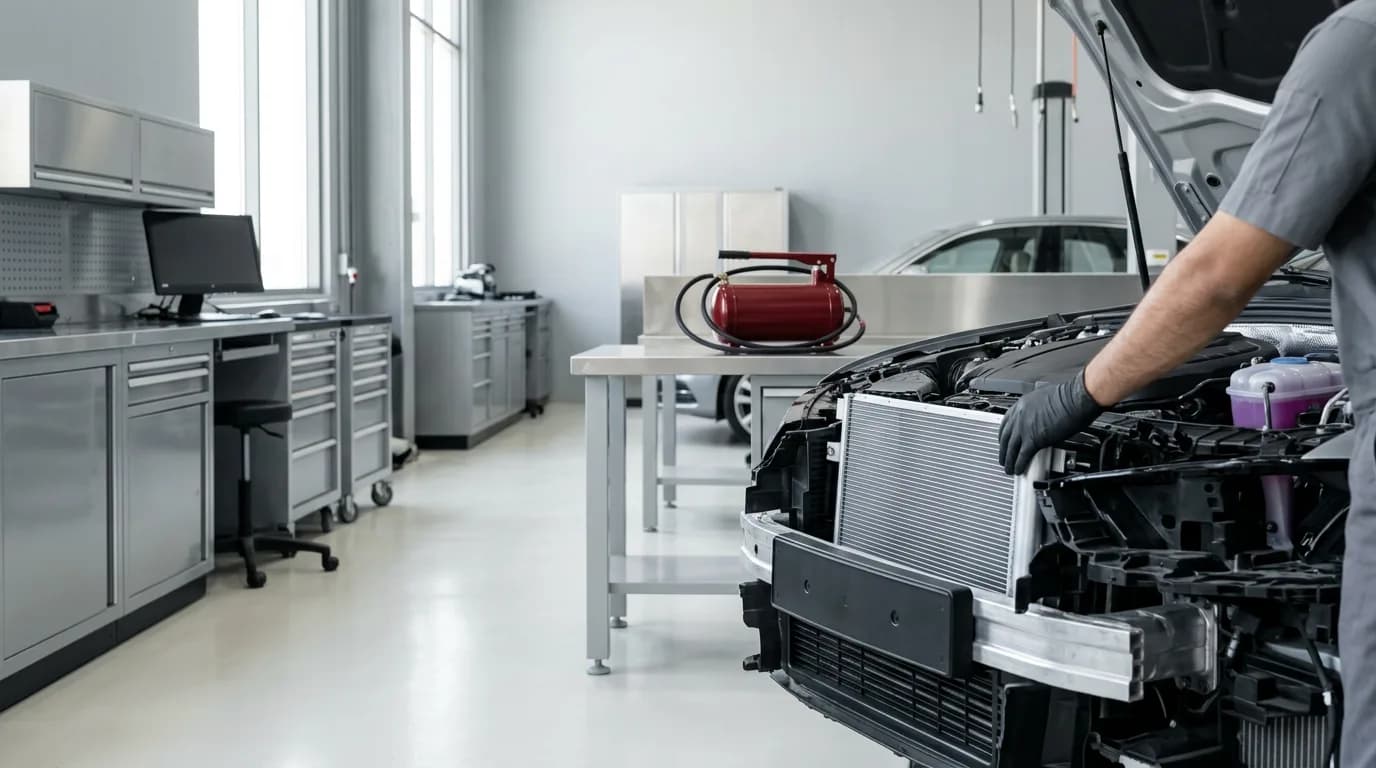
When does your Audi need a cooling system inspection?
You need an immediate inspection if the temperature gauge climbs toward the red zone in traffic, a green puddle appears under the car, the coolant reservoir keeps running low, or a sweet smell comes from the A/C vents — each sign points to a specific fault in the circuit.
- Temperature gauge rises in traffic
- Weak cooling fan or a thermostat stuck closed
- Green puddle under the car after parking
- Leak from the plastic flange or a radiator hose
- Coolant keeps running low with no visible puddle
- Internal leak — needs an immediate pressure test
- Sweet smell from the A/C vents
- Coolant leaking into the A/C evaporator through the heater core
Stop in a safe spot immediately
Pull over the moment the gauge hits the red zone; continuing to drive can warp the cylinder head within minutes.
Turn off the A/C and switch on the heater
Running the heater draws excess heat from the engine into the cabin, temporarily easing pressure on the circuit until you can stop.
Never open the radiator cap while hot
Hot-circuit pressure exceeds 1.4 bar; opening the cap instantly sprays scalding steam and coolant and causes serious burns.
Call a tow truck — do not keep driving
Have your Audi towed to the workshop; ten more minutes of driving can turn a simple pump repair into a full engine rebuild.
What does Audi cooling system service include?
The service includes a full pressure test of the circuit, locating the leak, replacing the pump, thermostat, or flange as needed, cleaning or replacing the radiator, checking the fan, and finally bleeding the air and refilling with genuine G12/G13 coolant.
- Circuit pressure test
- A pressure tester finds even the smallest leak in minutes, with no disassembly
- Water pump
- Plastic housing replaced when cracked or when circulation weakens
- Thermostat
- Replaced when stuck open or closed
- Flange
- Plastic housing replaced when it causes the green-puddle leak
- Radiator
- Cleaned of dust or replaced when clogged or leaking
- Coolant refill
- Genuine purple G12/G13, after fully bleeding air from the circuit
What are the components of the Audi cooling system, and how do they work?
The Audi cooling system is a closed circuit: the water pump pushes coolant through the engine, the thermostat controls when the circuit opens toward the radiator, and the fan cools the coolant before it returns — weakness in any single part pushes the temperature above normal.
The water pump on modern Audi EA888 engines has a plastic housing rather than the metal one used in older generations; this housing typically cracks between 80,000 and 120,000 km, and Riyadh's heat accelerates the cracking compared with the European climate.
The thermostat is a heat-activated valve that opens once the coolant reaches operating temperature; if it sticks closed, the main circuit is blocked and the temperature climbs fast, and if it sticks open, the engine never reaches its ideal operating temperature.
The flange is a plastic fitting that gathers the circuit's hoses at the engine; a leak there shows up as a green puddle under the car after it has been parked for a while.
The radiator cools the coolant by passing air through its fins; Riyadh dust clogs those fins about 30% faster than in Europe, weakening cooling even without any leak.
The radiator cap holds circuit pressure at around 1.4 bar; a weak internal spring stops it from raising the boiling point, so temperature climbs on long drives.
Purple G12/G13 coolant is an anti-freeze and anti-corrosion fluid formulated specifically for Audi and Volkswagen; mixing it with plain water or another type forms deposits that clog the circuit.
- Water pump
- Plastic housing, expected cracking at 80,000–120,000 km
- Thermostat
- Heat-activated valve that opens at operating temperature
- Flange
- Plastic hose-collection point at the engine
- Radiator
- Cools coolant by passing air through its fins
- Cooling fan
- Runs when stopped or in traffic to replace the airflow lost from driving
- G12/G13 coolant
- Purple in colour — never mix with other types
- Radiator cap
- Holds circuit pressure at around 1.4 bar
How do we diagnose and fix Audi overheating?
We start by reading the temperature sensor with VCDS, then locate the leak with a circuit pressure test, followed by a written cost report before any disassembly — and after the repair we bleed the circuit and road-test the car.
Read the temperature sensor
We scan the engine control unit (Unit 01) with VCDS/ODIS to read the actual temperature value and any stored fault codes.
Pressure-test the circuit
A pressure tester fitted to the radiator opening pinpoints the exact source of the leak without dismantling the car.
Written report and quote
We identify the failed part — pump, thermostat, flange, or radiator — with a clear price, before any disassembly.
Repair
The faulty part is replaced with a genuine or OEM part matched to your chassis number.
Bleed the air and refill coolant
We refill with genuine G12/G13 and purge air bubbles from the circuit using a dedicated bleeding tool.
Final road test
A real road test confirms stable temperature and correct fan operation, and the car is handed over with a written 12-month warranty.
What parts are used in cooling system service?
We use genuine or OEM water pumps and thermostats from Audi-approved suppliers, a radiator matched to the model, and genuine G12/G13 coolant — every part is checked against your chassis number before fitting and is covered by the written warranty.
- Water pump
- Genuine or OEM — part priced from SAR 450 to 900
- Thermostat
- Genuine, matched to the specific opening temperature of each engine
- Radiator
- Matched to the model and fan — aluminium with dual-row fins
- G12/G13 coolant
- Purple, genuine Audi anti-freeze and anti-corrosion formula
Does cooling system service differ by Audi model?
Yes; the A4's EA888 engine has a plastic water pump known for cracking early, while the Q7's V6 needs a larger coolant volume and a dual-row radiator sized for the car's weight and its large cabin A/C load — each model has its own full service page.
Ready to look at your car today
Initial computer diagnosis and a written report before any repair.
How much does Audi cooling system service cost?
Leak detection with flange replacement starts from SAR 350, a water pump with thermostat from SAR 900, and a radiator from SAR 1,200 — the final figure is confirmed in a written report after the pressure test and before any repair.
Large V6 models such as the A6 and Q7 cost more than the standard A4/Q5 range, due to their bigger radiator and larger coolant volume.
| Service | Indicative range (SAR) |
|---|---|
| Leak detection + coolant flange | 350 – 700 |
| Water pump + thermostat | 900 – 1,600 |
| Radiator (replacement) | 1,200 – 2,400 |
| Cooling fan | 800 – 1,600 |
| Code read + diagnostic road test | 150 – 250 |
Why fix your cooling system with us?
Because we diagnose overheating with a pressure tester and a real road test instead of guessing, use only genuine G12/G13 coolant, and fix the root cause instead of masking the symptom — backed by a written 12-month warranty on parts and labour.
- Precise pressure testing
- Pinpoints the leak without random disassembly
- Genuine coolant only
- G12/G13 prevents deposits and corrosion in the circuit
- Warranty
- 12 months, written, on parts and labour
Where do we receive overheating cases in Riyadh?
Our workshop is on King Abdulaziz Road in Al Olaya, and we send a tow truck immediately for any overheated Audi anywhere in Riyadh — from central Al Olaya to Khurais in the east and North Riyadh.
- Can I open the radiator cap while the car is hot?
- No; hot-circuit pressure exceeds 1.4 bar, and opening the cap instantly sprays scalding steam and coolant, causing serious burns. Wait at least 30 minutes for the car to cool down fully, or leave the check to our technicians.
- How often does Audi coolant need changing?
- Genuine G12/G13 coolant typically lasts up to 5 years or 150,000 km, but any leak or repeated top-up calls for an immediate inspection regardless of the odometer.
- Can plain coolant be mixed with G12/G13?
- No; mixing different types forms deposits that clog the radiator and the engine's fine passages, and it strips the coolant of its anti-corrosion properties. We fully flush the circuit with every fresh fill.
- How long can an Audi engine run before overheating causes damage?
- Just a few minutes after the gauge hits the red zone are enough to warp the cylinder head or blow its gasket; stopping immediately at the first warning saves you thousands of riyals — the difference between replacing a pump and rebuilding the whole engine.
- Does a coolant puddle under the car always mean the radiator has failed?
- No; most green puddles come from the flange or a simple hose, and only a smaller share from the radiator itself. A pressure test identifies the exact source before anything is replaced.
- Do you repair Audi cars towed in for overheating?
- Yes; we receive towed-in cars daily, start immediately with a circuit pressure test and a check of the cylinder head, and give you a written report of options and cost before any disassembly.
Related
- Causes of Audi engine overheatingThe full list of causes behind Audi overheating and what to do immediately
- Audi Engine ServiceRepairing engine damage caused by ignored overheating
- Audi TowingSafe transport for an overheated car instead of driving it
- Audi Service PricesA full price list for every Audi service in Riyadh
Book Audi Overheating & Cooling Repair now